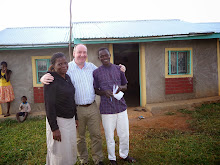
Friday, 8 April 2011

Perhaps we need a different anthem


It was a long drive today.

Moses and I went up to Kitale, to meet with Vincent and Rose. Vincent heads up our farming activity, running the farm that produces the maize that we use almost everyday in the staple food of this part of Kenya, ugali.

Ugali, for the uninitiated is a kind of maize stodge. It is essentially a blend of maize flour and water, cooked into a dough like porridge, formed into a large heap and piled onto a plate. It is traditionally eaten by taking a small piece from the pile, kneading it for a moment or two in your hand and then using it to scoop up sauce, gravy, chicken, fish, vegetables or whatever else is available. It is starchy, filling and inexpensive.

Kitale has been called the bread basket of Kenya. It is a green and fertile land to the north of Kisumu in Rift Valley province. It sits at around 7,000ft and consequently is cool and rainy. Perfect for agriculture.

I wasn’t looking forward to the trip. The last time I went, with David Lee, we travelled for more than four hours to get there on awful pot-holed roads. I am glad to say that, soon after our visit (though not because of!) the government embarked on an improvement program and the road is now a positive billiard table all the way to Webuye. It has cut two hours off the journey and made the town much more accessible.

We arrived at 12:30 to be greeted by Vincent and Rose and their beautiful children, Princess, Precious, Prosper and Perfect (2 girls and two, gorgeous, 6 month old twin boys).

Vincent, for reasons best known to himself, is an Arsenal supporter. He loves them as if he were brought up within a stones throw of the Emirates. I had stopped off on my way here to buy him a new Arsenal shirt. It hurt me to do so I have to admit, but I knew it would make him happy. That’s commitment!

Vincent was delighted and promptly put it on. He then waxed lyrical for ten minutes about “beautiful football” and how “we just lack goals”. Well, that’s the point of football as far as I can tell.

Anyway, he was happy.

So we moved on to talk of farming. We have big plans for our farm in Kitale and Vincent, as a teacher of Agriculture, is key to helping us realise them. But we aren’t quite ready to start this year, so we talked about farming the 10 acres we have farmed for the last few years.

Maize prices have rocketed and are currently 50% higher than two or three years ago. This puts a huge strain on our food budget for our work in Kisumu, so we have been growing our own for 7 or 8 years now. If things go well this year we will harvest more than 200 bags on November, enough for our work and a healthy profit to enable us to farm again next year.

Before we travelled back to Kisumu Rose prepared a wonderful meal of chapatti, Okra, Green Grams and Beef (and of course ugali for Vincent and Moses!). It was a feast and washed down with English tea (black with a little milk, compared with the Kenyan way of very milky and at least 3 teaspoons of sugar) - Rose has known me long enough to know I prefer it the English way!

As we ate, the TV screen broadcast images of Kenyan leaders live at their pre-trial hearing at the International Criminal Court in the Hague (six leaders are charged in connection with the post election violence in early 2008).

The court proceedings were formal and official, but I was amazed to see the number of politicians who had travelled from Kenya to the Hague to offer support to those suspected of inciting serious violence. Nothing to do with the trial, which is only a pre-trial to decide if there is a case to answer, the politicians had, nonetheless, travelled all the way to the Netherlands to appear on TV showing support.

As the news channels broadcast pictures of them stood outside the court, singing the Kenyan national anthem in support of their indicted colleagues inside I couldn’t help but reflect.

The cost of a flight to Amsterdam and a hotel in the Hague for 4 or 5 nights is the equivalent of our farming 10 acres to support over 75 children in orphanages, rehabilitation and home resettlement programs.

Maybe, just maybe, we should be singing a different kind of anthem. One for the hungry children, widows and orphans of this beautiful, fertile, rich land.

As I got back to Kisumu it was raining. At last the rains we have hoped for had come. Better than any man’s, perhaps we have God’s blessing on our work.

Thursday, 7 April 2011

I study because I like to know things


This is Samuel. He hasn't had the greatest start in life, but I was lucky enough to spend half an hour or so talking with him this morning.

He is the most delightful young man.

He is in the first term at Rang'ala Boys secondary school. And he loves it.

He never believed he would go. Four years ago his marks at primary school were poor. You need at least 250 out of 500 to get a secondary school and he was getting marks in the 100's. But Samuel found a place to settle in our home at Mamboleo on a hillside on the outskirts of Kisumu.

He also found inspiriation in a another pupil who befriended him at his primary school.
His friend, a girl in the same class, encouraged him to achieve more. She was scoring around 300 and looking forward to secondary school.

Through sheer hard work Samuel studied and studied. His marks improved each year until, by class 8 and his KCPE exams he managed the remarkable score of 280.

He was overjoyed.

Still he didn't get a letter calling him to secondary school, so Moses and Paul James set about finding him one. We already have 2 boys in Rang'ala, Shadrack and Atenas, both in Form 2 and both loving it, so Moses and Paul James went up there to see what they could do.

After much pleading they agreed to take Samuel, knowing what good students Shadrack and Atenas had proved to be.

Samuel started in the middle of February, 3 weeks after everyone else, but his attitude is the most refreshing I have come across in all of our children.

Other boys there ask him what mark he got in KCPE, he simply says that it isn't about the past, but the present and he only lives in the present. He says that they only passed their exams by cramming, but he studies because he likes to know. He is sure he will overtake them

Despite missing 3 weeks of the first term he has scored above average in the end of term exams. He reckons he will be in the top 10 before he reaches form 3.

You know, I think he just might

Wednesday, 6 April 2011

Bio Sand Water Filters

I knew Moses was serious about this trip. Last night he left me saying that he would pick me up this morning at 8:00am. In Kenyan time, 8:00am means anywhere between 9:30 and 11:00 depending on how slow breakfast was and what else proved to be more interesting in between

But this morning Moses showed up at 5 minutes before 8 o’clock.

I also knew that this was a serious trip, because he showed up in the land rover, not the little Toyota for running about town.

“Are there going to be some rough roads today?” I enquired naively. His reply was non-committal, which I took to be a firm yes. Kenyans say so much without words.

Moses, it turned out, was good friends with a man, Sebastian, who was now a bishop somewhere in the middle of nowhere. He used to be in Kisumu, running a thriving church, but his wife, also a pastor, had begun a church in their rural home and this too was doing remarkably well. They took the decision to move away from Kisumu and found a new pastor for their city centre church.

Whilst in Kisumu Moses and Sebastian had forged a friendship, based partly on their mutual calling, but also on their love of engineering and technology. Back in the rural home Sebastian, never one to sit still, had heard about an organisation called Connect Africa and begun to work with them.

Connect Africa are based in Kampala, Uganda. Their Director is an energetic and passionate Canadian man called Trevor. Trevor travels the world on behalf of Connect Africa, looking for technology and innovation to bring back.

But he doesn’t import things, he instead finds local technicians, engineers and scientists to make African versions from local materials.

And so it was with the Bio Sand Water Filter.

In essence, it’s a small concrete case filled with sand (the type is important) and gravel. You pour in water and good “living organisms which grow in the bio layer” (see, I did pay attention) filter out the things that could kill you or make you sick. When you are ready, you pour in more water and you get the clean, processed water out of a spout conveniently located at jerry can height

It was developed by the Universityof Calgary, Alberta and made by 12 local men from rural kenyan villages, from local materials

We travelled the bumpy dusty roads of Nyanza province to a homestead in the rural area where Trevor, Gilbert, his chief technician and the rest of the team had set up a demonstration area.Mighty impressive it was too.

From there we travelled with Trevor and the team as Connect Africa donated filter units, manufactured by local people in Busia, to schools and community groups around the region. At each place we were warmly received and the filter units accepted with joy.

We talked about possible applications for the units in the slums of Kisumu where we work. Places where clean water is next to impossible to find and sickness takes away too many lives.

Trevor and his team donated a unit to us and promised to come and see us again, to talk about a possible partnership. We could be enabled to make units ourselves, for slum support, home repatriation and rural reintegration programs.

Whatever comes of it, I have enjoyed a day with people passionate about making life better for ordinary African people.

Africa may well be better, connected.

Tuesday, 5 April 2011

Encounters with Chameleons


This afternoon in Kibos we went for a walk, to look around and pray over the acre or so plot that we are roughly farming.

There was me, Moses, Tatu, Paul James, Kennedy, who has been working over the land and planting maize and John and Dominic, two of the boys from Kibos who broke up from school this morning for Easter
(pictured at Kibos this afternoon)

We crossed the dusty red road, rutted from the tractors that run up and down with their full loads of sugar cane bulging from iron cages pulled behind them.

As we walked down an older man was burning wood close to the road side, filling the air with smoke as he turned branches into charcoal for the cooking fires.

Close by his wife gathered the smaller branches into bundles to sell for firewood. They would well for up to 100 shillings per bundle at the market (about 80p) – enough to put a small meal on the table.

By the side of the road Tatu suddenly stopped and stared. I had walked by before I noticed, but turned round to look. There, crawling out of the grass, getting away from the fire, was a chameleon, bright green against the red road.

It struck me that, if this chameleon was any good, it would have been red by now, but, vivid against the dusty track it wandered forth and began to cross.

Fearing for its safety amongst the motorbikes, cars and tractors that plied this route Moses dashed over and, as his wife recoiled in horror, bent down and picked the chameleon up.

The little lizard spat and tried to bite, not realising that he was only meant well, that he would soon be put in a lovely patch of greenery, away from the dangers of the road.

As I shared in fellowship at the Kachok rubbish dump this evening it struck me what a metaphor the chameleon provided.

The boys we look after often find it hard to change their colours quickly. The life they have known is one of hardship and struggle, one with no discipline, where no social skills are required, they are in a grass that is slowly burning around them, and they don’t know how to get away.

Some of them take the quickest route, straight into busy roads.

For them, the vehicles often get them. Their four wheel drives, tractors and motorbikes are glue, drink or drugs. Death may be slower, but it’s just as inevitable.

And then there are those who are picked up and turned around. They may kick or bite a little in the early days, but they soon find themselves in patches of green. I sat with one such boy this afternoon in Kibos. He had found it hard to settle, but now felt at home. The other boys are like his brothers and Moses and Tatu his mum and dad.

The colours of his street life have gone and he is studying for his KCPE exams, with hope for his future and security at home.

Its better in a safe place than wandering the streets, whether you’re a small green chameleon, or a child without a home.

Friday, 1 April 2011

Big dreams and small footsteps

It's that time again.

I am preparing for another trip to Kisumu. I feel a mixture of anticipation and excitement at seeing old friends again and sadness that I will be away from home for a couple of weeks.

It's always good to see Moses and I am really looking forward to meeting up with him. 2011 has been a hard year for him. We always struggle in January and February.

We have so many children who need an education, whose hopes for the future rest on getting through primary and hopefully secondary school.

But the fees are crippling. I don't know how ordinary Kenyans manage.

It costs about £350 to put a child into secondary school, and then you have to buy uniforms and books and shoes and all sorts of things on top.

We have more than 30 children in secondary school this year, children we believe are the Isaiah Trust's family. In return for support, love and care we expect the children to work hard and make the most of the opportunity they have. For some this is easy, but others struggle with the discipline required to study and with sitting in classes with children much younger.

There isn't an easy answer, I guess if there was then many of the problems that have beset the continent, let alone just this country that I have grown to love, would be solved by better men than I.

It's just that, when we are trying so hard to get our children into schools and to give them the best that we can give, the schools don't seem to want to help.

They have become really petty in checking all the equipment is correct. One child was sent home from secondary school where they had reported because they didn't have the correct tupperware plate, another may have been missing a jumper. Not a reason, I don't believe, to deny them classes at the start of the school year. Not when we are running around trying to get lots of different children into lots of different schools.

How is a country going to get out of poverty when it sends its children home from school for stupid reasons.

I have felt really sorry for Moses and Paul James. Normal parents have 2 or 3 children to sort out, but every January they have nearly 100. I don't know where we would be without their faithfulness and their love for the children.

So I am going to spend 10 days in Kisumu. I plan to visit schools and meet with some of the headteachers, encourage the children to do well in their exams. This is the fruit of the hard work that Moses puts in.

As for the children, I will carry good wishes from England, encourage them in the studies and try to give them a picture of hope for their futures.

Big dreams start from small footsteps

Thursday, 30 September 2010

A Bigger Vision

It's that time again.

I fly to Kenya in the morning, to meet up with Moses and the team in Kisumu. I am excited about this trip. I am going with David, a friend I was introduced to by Nicky. David is feeling a real call to supporting the work in Africa by doing what he knows best. Farming.

So this trip is all about the farm. And about making some of the work out in Kenya self sustaining. It will be a challenge. For the last few years we have leased 10 acres of land in the fertile highlands around Kitale, some three hours to the north of Kisumu. The land has provided enough harvest to ensure food supplies for the project for the year, with over 200 bags of maize filled up. We use about 100 for the work with the street children and in our orphanages and homes, the rest we sell to pay for the following years harvest.

But we have a bigger vision than that.

Our hope is to rent more land, to see a bigger harvest at a lower cost. We would like to ship out a couple of tractors, which can plough the land and make a rental income when they are not working for us. We would like to grow higher yield maize. We would like to establish a training centre and college where the boys currently on the streets or in care can come and stay and learn a trade and profession. We would like to earn enough from the surplus to fund, not only the college, but a buillding program to take more boys off the streets.

In short, we would like to make the project more self supporting and give the people who work out there food security. In Africa, that's a big goal. It's only a dream. We only have a vision and a prayer.

But we will see what the week brings.

I am excited.

Monday, 20 September 2010

Tim's Great North Run

Just to say a huge thank you to everyone for their support during the Great North Run.

I completed the run in 2 hours, 25 minutes and 57 seconds, just as the heavens opened and the rain poured down on South Shields. It had been a really good experience up until then….

It’s an incredible feeling, standing in a crowd of 50,000 or so people, all of them running to raise funds for causes close to their hearts. As we were taking our positions at the start, on the central Motorway in Newcastle, the tannoy announcer asked us to take a couple of moments just to take in everything around us and to remember those that we are running for. For some people this was a poignant moment of reflection and recollection of loved ones no longer around, for others, perhaps, the thought of a cause close to their heart.

For me, as the strains of Abide With Me played over the loud speakers, my mind went back to Kenya, to the children there that we help and support, for all those that help to change lives amongst some of the poorest and most neglected communities.

“I fear no foe with Thee at hand to bless;
Ills have no weight, and tears no bitterness;
Where is death's sting? Where, Grave, thy victory?
I triumph still, if Thou abide with me.”

The music stopped and I looked around. It was almost time to go. What was that line? “I triumph still …”

On the big screen Ant & Dec set off the wheelchair runners, then the elite women and then it was our turn. They introduced Haile Gebrselassie and I knew then that the competition for this race would be a bit stiff. Oh well, it was never going to be easy.

And then we started to move forward, edging slowly towards the start line. I took off the bin bag which had been fashioned into a raincoat to keep my warm and dry until the start, excitement and nerves tingling down the back of the neck. This was it.

I crossed the start line 16 minutes after the illustrious Mr Gebrselassie, the chip timer firmly fixed to my running shoes beeped loudly, along with the hundreds of others attached to my fellow runners, and then we were off. Running down the motorway towards the Tyne Bridge the route was lined by hundreds if not thousands of people who had, rather sensibly, decided to watch instead of run.

After half a mile I rather wished I was one of them.

As I approached the Tyne Bridge I heard a roar. Thinking that maybe a large supporters group had just spotted me going past I looked up, just in time to see the red, white and blue smoke trails of the Red Arrows arcing over the iron girders of the bridges arches.

In front of me a sea of people, jogged inexorably towards South Shields.

The rain that dogged us prior to setting off had given way to a cloudy, muggy morning as we ran down to the roundabout, where Blaydon Races played out through large speakers, welcoming us to Gateshead.

I ran past a group of army guys in camouflage gear (must have missed them at the start?), running along with ridiculously heavy packs on their backs. As if it wasn’t hard enough! I sped past Wonder Woman, Spiderman and a shark, before being overtaken myself by the Fun Running Criminals.

A water stop at the 3 mile mark was very welcome, as were the bands on route who provided a musical backdrop to the pain I was feeling in my legs. The crowds had come out to the roadside now the rain had stopped and they encouraged, clapped and shouted as we went past. A group of young lads had obviously been for a raid on the Aqua Pura stand, as they had an array of squeezy bottles, which they aimed at vulnerable looking joggers.

The miles ticked past, 5 miles, then 6, then the halfway marker. In my mind I began to run back from places I had trained. “Well, if there are only 6 miles to go, then that’s like running back from Salterforth, along the canal, by Foulridge Wharf. I’m sure I can manage that”. The trouble is, the 7 mile marker never came. I strained my eyes ahead, thinking it must be imminent, but all I could see was a tide of runners heading for the coast.

Then, as I headed over the brow of a hill, the 8 mile marker approached. Oh, the relief! A whole mile further on than I thought!!

At about the 11 mile mark the run reaches South Shields and the dual carriageway is lined with houses and shops. Outside the houses, set up on the pavement, were all manner of tables and chairs offering sustenance. Jelly Babies, orange segments, drinks of water and coke and, almost unbelievably, one chap offering plastic cups of beer. He seemed to be doing brisk business, but I have to say that I declined his kind offer. I would save that pleasure until the race was done!

Then, suddenly, the road falls away, down towards the sea. The crowds increased and clapped and shouted encouragement. I headed down and turned left, to run the final mile along the sea front. The distance counted down, 800m then 400m then … well, you get the picture. It was quite moving.

I crossed the line, some two hours after the aforementioned Ethiopian, but in truth we both won our respective races. His was to confirm his status as one of the worlds greatest ever athletes, from humble beginnings in Africa, running the 10km to school every day clutching his school books, to the top of the world stage.

Mine was about humble beginnings in Africa too.

Thanks to everyone who has sponsored me, or any of the other 13 people who ran for the Trust this year. If you are inspired to make a difference, why not think about running next time?

We all met up on a grassy bank overlooking the sea in South Shields, clutching our goodie bags and medals, wrapped up in shiny space blankets to ward off the cold and the rain and etching a smile into pained faces as the camera flashed away.

Then the heavens opened.

It absolutely poured down. Rain like they only do in the North East. Or one of those tropical downpours we get in the afternoons in Kenya. But not as warm.

I looked around at the tens of thousands of other people who shared in this moment, at the friends and colleagues who had put in hours of training, covered hundreds of miles over the previous days, weeks and months, just to get to this cold and wet bit of coastline. And I was proud of us all.

"Who like Thyself, my guide and stay can be?
Through cloud and sunshine, LORD, abide with me"