Sunday, 25 November 2012

Nursing a Dream


Today was Sunday. It doesn’t need planning, it’s a day for the church family and our Kibos family.

I woke early as I always seem to do at Sunset. The light of dawn streams through the fly screens that pass for windows above the big sliding doors onto the balcony. The birds scurry and scutter around the trees and the water hyacinth, brought in by the overnight tides, cover the once blue lake with a cloak of verdant green.

Anton arrived ten minutes earlier than we had agreed. Regular readers of this blog will appreciate that this is a miracle at least on a par with feeding a crowd of five thousand hungry mouths on a hillside above Lake Galilee with a couple of loaves of bread and some fish. He told me that on Sundays they are now trying to work on English time (as opposed to the ubiquitous “African time” where hakuna matata was the norm and promptness was for those with a hurried outlook on life). After talking with Anton in the car as we made our way through the busy market streets of Kondele things became a little clearer. The church had begun to flourish when they asked people in the village why they didn’t come “you go on too long”, “you are too late”, the “meetings last a long time and I can’t manage the things I need to do as well”. So, in a radical cultural move, they had committed to starting on time and to finishing no later than 12:30.

As I approached the church it was clear that it had worked. The church was full of people, listening attentively to Pastor Hezbon’s teaching session (9:30 to 10:30 prompt)

Hezbon is a lovely man, a former hotel manager who came to the church the very first Sunday we opened in 2004. In 2007 he felt called to give up his work and turned to bible college, where he graduated a couple of years later. He is now the pastor and teacher of the church, situated just 600 yards from where he was born.

When Hezbon had finished Moses introduced a guest to the church.

Fred Okello runs a small children’s organisation he set up himself whilst he worked as a teacher. It is called Onyalo Biro Orphans and Widows Project (Onyalo Biro means "It has arrived"). Fred now works for the organisation full time, promoting a special purpose and a very specific message. He introduced himself, and talked about why he was here. He was touring the area with a small group of primary school children because they wanted to preach a message to the church and to the community as a whole, as the march 2013 presidential elections draw near

It’s a message of peace.

In 2007, the last time elections were held in Kenya, they were followed by a time of unprecendented protest and violence. Kofi Annan had eventually brokered a peace between the factions, but not before tribal lines had been drawn. People had been forced from their homes, repatriated to their homelands and a number had been killed in violent and bloody protest. Kondele, just a mile or two from Kibos, on the way to the city centre, had been a catalyst for the troubles, with roadblocks and gunfire night time companions.

The children sang songs and read poems they had written. Songs that reminded their fellow Kenyans that they lived in a beautiful and rich land, from the fish of Lake Victoria, to the snow capped peaks of Mount Kenya and the Flamingo filled lakes of Nakuru and the Rift Valley. They sang that theirs was a future to believe in and to hope for, here was a generation pleading for peace, for factions to live together in mutual respect and regard.

I found myself listening to them with tears in my eyes, hoping beyond hope that they would see their dreams for their country come true. Changing the stigma of past generations, the pain of past wrongs and the hurt of past prejudice is not easy. But the children made us all see at least some hope for the months and the years to come.

After church I made my way to Kibos, our rehabilitation centre and home to more than 20 children. The holidays are just beginning, as the Kenyan school year comes to an end and the house was filled with the sounds of children tucking into lunch, hungry from their morning Sunday School.

These moments after church are important times to meet up with people, to chat and to hear from some of the children one to one.

I talked with Boniface and Cosmas, old friends from Kachok, with Shadrack (form 4 next year) and Stanley (new to Mamboleo in March), with Henrietta (looking for a nursing or community health course at college) and then I talked with Sheila.
 
Sheila’s story is, like so many of the children we care for, fraught with sadness. Her father walked out on them, and her mother left the rural home for life in the slums of Obunga, on the outskirts of Kisumu. Unable to take care of Sheila she often found herself in the care of her grandmother, an elderly lady who took in washing to try and make ends meet. Sheila’s mother eventually disappeared and her grandmother fell ill and moved back to her rural home. Sheila, in her final year at primary school, was left alone.

It was here that John, our social worker in Mamboleo came across her, alerted by the school to the tragedy that had unfolded. John introduced her to the Trust, initially to the education programme where she was supported in her primary school studies. As her home situation became clear she moved to Kibos, to the care of Moses and Tatu, and made friends with the other girls we support.

Sheila did well in her final year at primary and has spent the past four years at secondary school. In the last week she has completed her Form 4 exams and will find out in a couple of months what the future holds. She is predicted a grade B- or C+

I talked with her about her dreams, her ambitions. Her eyes lit up as she talked about her hopes. She told me that she had, since she was 7 or 8 years old, wanted to be a nurse, to serve others.

If she gets the grades she is predicted, then Sheila will be able to join college in March next year, for a diploma in Nursing. The fees are expensive, but I know that they will be provided. They always have before.

Sheila’s is just one story, there have been many more today, and there will be many more this week. They fill me with hope for a new generation of Kenyans, rising out of the ashes of personal tragedy, determined to make the most of what life offers.

It's times like this that bring it home to me, this is what the Trust does, it’s what our donors and supporters help us to achieve. It makes me proud, and once again my eyes are full of tears as I write.

I have sat and watched as children have pleaded to the adults of the community for a peaceful, hopeful future, sat and listened as a young girl shares the hopes she has for a life lifted up from despair in order to bring hope and comfort to others.

And I am reminded that Jesus took a child in his arms and said “the kingdom of heaven belongs to such as these”.


Saturday, 24 November 2012

Red Rumps and Red Skies


I woke late this morning.

I pulled back the curtains on the large window that overlooked Nairobi National Park. The skies were cloudy and grey and the air smelt damp and fresh. There is a smell that is distinctly African. One that strikes me each time I step from the plane in Nairobi, when I walk the rural lands in Nyanzaa or when, like now I gaze out over the wild plains. It is the smell of wet red earth, dampened by overnight showers, the scent of the open plains, acacia trees and grassland. The unmistakeable fragrance of freshly cooked bacon. Or that last bit could have just been the hotel restaurant a couple of floors below.

As I look out, a red-rumped swallow soared effortlessly past the window and settled on the telegraph wires that ran parallel with the wire fences that separate the terrace bar from the wild animals of the national park. These remarkable birds, no more than a few inches long spend their summers in Southern Europe, before beginning their 4,000 mile journey to winter in the warmer climates of sub-Saharan Africa. It is an amazing feat for such a fragile creature.

I was a little behind them, having arrived just the night before.I had enjoyed a cold Tusker on the terrace when I arrived, after a frustrating journey through Manchester and Paris, before a very empty flight and the courteous service I always enjoy from Kenya Airways.

We had landed at the airport a little early, at 9:30 the previous evening. 

I made my way through the familiar chaos of kiosks and shops to the immigration and visa counters.To my delight there was no queue ahead of me and, having printed off the visa forms at home, I was well prepared to go straight to the counter.

“Jambo”, the official greeted me with a cheerfulness I had rarely encountered there previously, “how are you?” she said.

I replied that I was fine, and handed over my documents, including my brand new passport, renewed less than a month ago.

“Ah”, she said, “you have been here before. I can see that you are on our system”

You could have knocked me down with the tail feather of a red rumped swallow.

I don’t know quite what surprised me most – that I was known to the Kenyan government, or that there was, in fact, a system!

She asked about Kisumu, about the Trust and the queue behind grew steadily longer as my less prepared fellow passengers completed their visa forms.

“Welcome” she said finally, and handed back my passport, with a visa now adorning one of it’s pages.

A short taxi ride took me to the hotel and a good nights sleep, accompanied by the familiar sounds of the African night (taxi drivers beeping their horns loudly and the incessant calling of yellow weaver birds in the surrounding trees).

I drew the curtains back fully and looked out at the park. 

Nairobi National Park is a relatively small park, squeezed on three sides by the urban sprawl of the city, with just a small corridor at the southern end for wildlife to make their way down to the great pains of the Maasai. Locals complain about wildlife intruding into the city, about attacks by wild cats on domestic animals and cattle, but it’s no surprise, when the fences erected to separate the two are stolen and sold for their metal.

Around 11:00 I made my way back along the crowded roads to the airport, for the early afternoon flight to Kisumu.

The short flight west often affords far reaching views across the volcanic plains of the rift valley, as far as Kilimanjaro to the south and the rising snow capped peaks of Mount Kenya to the north. But today the small plane rose through the heat haze to a sky filled with majestic cumulonimbus. Rising from a flat base the clouds are pushed thousands of feet into the air by the warm thermals. Thick with the promise of refreshing rains they bump the plane this way and that as the pilot moves left and then right, surfing across the white slopes of the clouds. They are at once beautiful and threatening, the power to create thunder storms and the promise of water for a parched land.
 
And then the turquoise waters of Lake Victoria appear. We begin our descent to the small lakeside airport in Kisumu.

Moses, Paul James and Anton are there to meet me.

It is good to greet old friends and colleagues. We have great mutual respect and affection and I couldn’t imagine them ever not being in my life.

Anton tries his best to open the boot of the car “It is so secure”, says Moses, “that it even refuses its own key”. Eventually he succeeds, bundles in my case and we make our way through the familiar streets of the city to Sunset Hotel.

“Mr Tim Broughton” announces the receptionist as I walk in.

Nothing like making an entrance! It’s good to be back. The room is shabby and familiar, the lift only works if you hold the button down, the hotel walls are covered in mosquitoes looking for a good meal.

But the people are warm and friendly, the grounds are beautiful and the view is to die for.

Moses, Anton and I spend an hour or three catching up and planning the week, before I am left alone for the evening, to prepare for church tomorrow.
 
As I looked out over the lake the sun slowly slipped from the sky, setting fire to the mountains and the lake as it kissed them goodnight.

It feels good to be here again, to meet up with old friends and colleagues, fellow pilgrims on a journey, writing stories and living our purposes. It's good to be reminded, as well, of the wonders of the world in which we live.

Whether it is the amazing inter continental journeys of the red rumped swallow, the powerful and majestic cumulonimbus or the fiery sunsets over Lake Victoria, I know that I am lucky to live in such a beautiful world. And even luckier to know it’s creator.

I am looking forward to the next few days in Kisumu.

Are you in a hurry?


“Are you in a hurry?” the man in the smart suit in the seat next to me asked?
“Well, I do have a connection to catch” I replied, trying to look eager to be let out of my seat, as the other passengers on the small Flybe flight between Manchester and Paris filed steadily past us.

“uh, ok” smart suited business man grunted and began to collect together his belongings.

I sat in my seat frustrated. Not just because I was unable to get out, but because even when we disembarked the plane we would only get as far as a bus to take us to the terminal nestled somewhere in the far distance.

I hastened down the steps of the plane and onto the transfer bus. A small crowd had assembled on the windy tarmac outside the front and rear doors of the bus. It was a tight squeeze and it wasn’t clear how all of the people that just got off the plane were going to get on. Then I noticed that those who were outside were engaged in animated discussions with French Airport Officials (made official, of course,  by the fact that they were the ones with the high-vis jackets on), clearly suggesting that a second bus was necessary.

After a further ten minutes of frustrating inactivity one of the rebellious minority stepped onto the bus and announced that the officials had told him that there was no second bus and we wouldn’t be going anywhere until everyone got on this one.
A busy matatu

Accustomed as I am to African matatu’s, which don’t just take an excessive number of passengers, but their luggage, their children and their chickens, I squeezed myself into the most uncomfortable position I could muster, with a handbag digging in my back and an arm reaching up to the nearest grab rail centimetres from my head.

We didn’t so much disembark as fall into the terminal building when the bus doors opened. It was a relief to breathe again.

I consulted the connections board to see where my, now impending, flight to Nairobi went from, to discover that it only required a short walk. Unfortunately it then required another bus trip! I had thirty five minutes before the flight left and was starting to worry.

Thirty minutes later, as I sat in my seat on the Boeing 767 to Nairobi, slightly redder and a lot more out of puff then when I had begun my journey, I reflected on Mr not-to-worried-about-getting-off-the-plane-business-executives comment to me.
“Are you in a hurry?”

I guess I spend much of my life in a hurry, keen to get a day at work done, keen to reach the weekend, keen to go to a dinner, a concert or an event, keen to get to the next thing that makes me feel better, the thing that makes working life feel like it is worthwhile.

But I am also learning that sometimes I need to have patience, because there is a bigger story being told. In the book of my life I am rushing to get to the end of the chapter rather than appreciating how it builds into a whole (I so nearly wrote “hole” then – that would be a more tragic book entirely!)

In Kenya too, I am eager to see the next big thing, to celebrate milestones, to write about success stories. But the work of the Isaiah Trust there is still building. The story hasn’t finished yet.

I am about to begin another chapter, I am eager to meet up with Moses and Tatu, to meet Paul James and his new wife, Nancy, and most especially to hear about the children we support and care for. Their school year is coming to an end, they will be starting to come home for the holidays and I am looking forward to all that they have to say.

The sun will burn me, the roads will frustrate me, the timekeeping of my wonderful African colleagues will challenge me.

But the stories and the faces and the chapters we are writing together will bless me.
I am in a hurry, but so much that I can’t savour the words over the next week or so.

Sunday, 18 March 2012

Reunions and Goodbyes

My last morning in Kisumu before the afternoon plane home could only really be spent at Kibos church.

Nicky and I enjoyed breakfast together at Sunset, before Anton came to pick us up. I packed my case, paid my bills and wished goodbye to the staff.

I have been coming to Sunset Hotel, overlooking Lake Victoria for 8 or 9 of the last 11 years since I first came. It has become a familiar second home. The staff greet me warmly by name “Hi Tim, How are you?” is asked of me at least two or three times a day and I have to say that I enjoy this familiarity.

I also enjoy the gardens and the birdlife. It is a place to think and to be at peace. It is an open air office for meetings and rich in illustrations for a budding preacher. This morning as Nicky and I sat waiting to be picked up a chameleon scuttled up and down the tree in front of us, a beautiful shining blue, the colour of the jacaranda flowers in the branches high above.

We had arranged to be picked up at 10:00.

Sure enough, on the dot of 10:35 Anton arrived. It was market day and the traffic was slow on the roads around Kondele. I loaded my case into the dusty boot of the Toyota and we headed for Kibos.
This has been my church ever since we built it in 2002.
I can remember standing on the land as the timber frames were erected and the poles sunk into the ground, to be covered in concrete.

We had no idea if we would find a congregation amongst the varied houses and compounds that make up our village, just outside Kibos on the outskirts of Kisumu.

But today the church is flourishing. I guess we could do with some more seats and benches really, but we always seem to cram people into the available seats. The space at the back where we don’t have chairs, well that’s used for dancing.

As we pulled up at Kibos Anton let us out of the car at the house so that we could walk the hundred yards or so to the church.

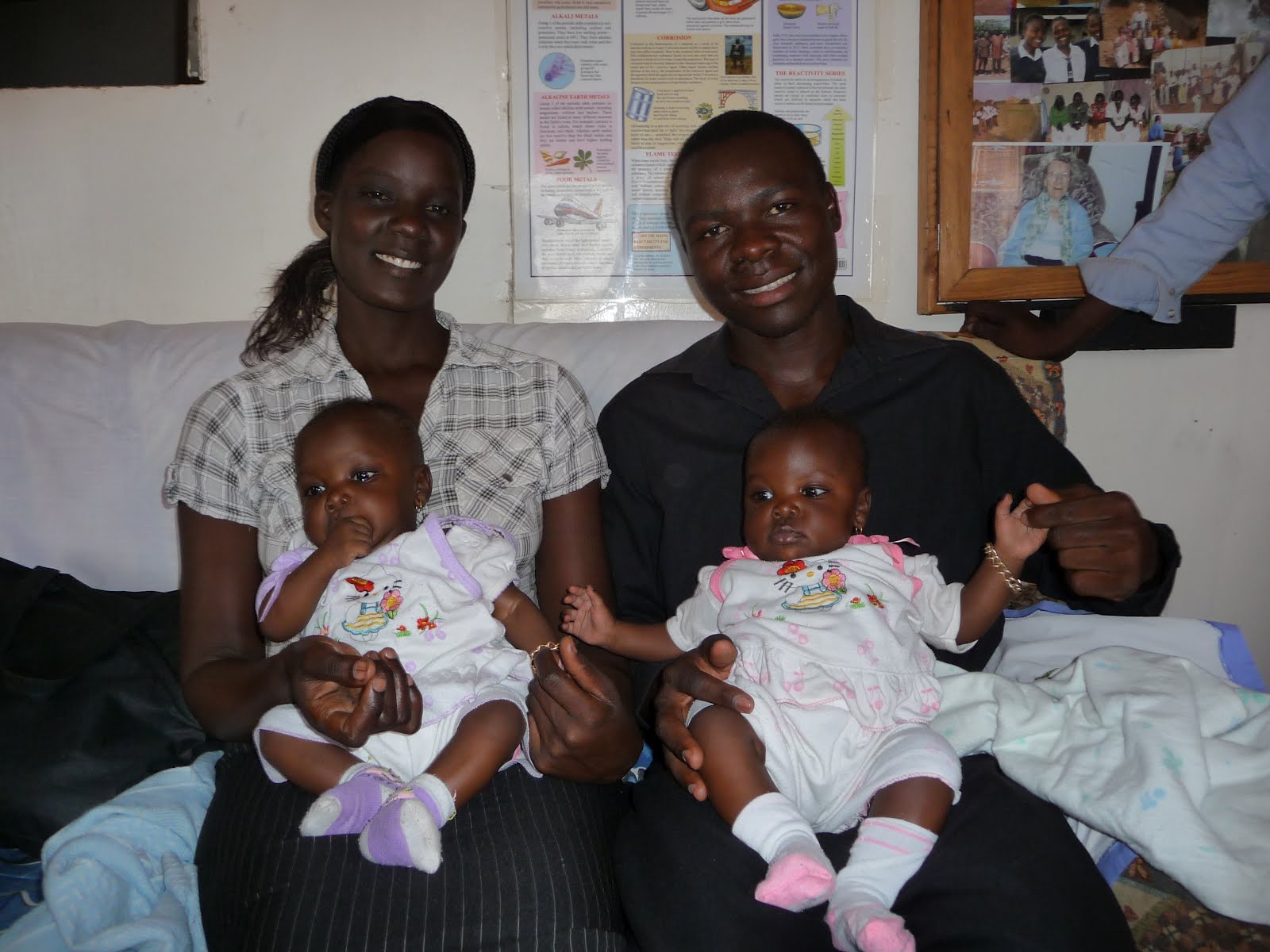
I heard Nicky squeal with delight and turned round to see a real sight for sore eyes. Maynard, his wife Carolyn and their two 6 month old twin girls had just arrived on a couple of boda boda’s (obviously the children were being carried by their parents – although I have seen worse on Kisumu’s streets!)

We were thrilled to see them.

Maynard was in the very first group of boys we took in from the streets almost 10 years ago. He lived with Moses and Tatu at Kibos, progressing through school, before finding his independence. He now works with the Matatu’s, that ply their trade on Kisumu’s roads

We walked with Maynard and Carolyn to the church, where Moses was doing bible teaching.

Kenya church starts at 8 with prayer. Bible teaching from 9 until 10:30, then praise and worship for as long as it takes. The preacher usually comes on after 12 and often wont finish until well after 1pm. It’s a commitment that increasing numbers are staying all the way through.

Moses is a really talented worship leader. There is a small worship group in the church, with varying talents, and they provide backing and harmony to the songs. Isaiah tapped away on the keyboard, before Anton came on to play for the last couple of songs.

We sang and danced like it wasn’t 30 degrees and lost ourselves in wonder, praise and thanksgiving, the time just didn’t matter.


Then Moses invited me to preach the main message, which I happily did

I talked of Abraham, about his journey. About how God told him to leave the place he was and to walk with him. Abraham packed up his things and left. We are told that he camped between Bethel and Ai, between restoration and ruin, between the rubbish dump and the place of new life.

It was a picture of Abrahams prophetic destiny, brought about wholly be the grace of God. It also spoke to me of our vision, of our destiny, of our calling.

We are on a journey.

We made the choice, like Abraham, to step out and go when we were told. We haven’t reached the place of full restoration, that will come later when the least of these children will be first in the kingdom of heaven. But we, like Abraham, are now somewhere between Bethel and Ai, believing and trusting n God’s promises.

I thought back to my own promises, to Isaiah 58.

“I will be with you always. I will meet your needs in a sun scorched land”.

We are journeying, in the strength and by the grace of God.

In the great scheme of things, we have affected just a small number of lives here in Kisumu. But our boys are now spread out across Kenya, with children resettled in Mombasa on the east, Nairobi in the centre, Kitale and the Sudanese border in the north and of course Nyanza and Western province where we are concentrated,

Our first children are growing up and maybe, like Maynard, will soon have beautiful wives, husbands, children and families of their own.

I hope and pray that will be so, because I am a son of Abraham, an inheritor of God’s promises to him and like the stars in the sky I believe that our children will be so numerous they cannot be counted.

I felt so blessed today as I ate green grams and chapati’s in Kibos with Moses, Tatu, Maynard and Carolyn.

I was sad when it came time to depart for the airport for the short flight to Nairobi, clutching my gift from Moses of a CD of his debut album. I will play it when I get back to England. I will be happy to see my gorgeous family again, but sad to be leaving my beautiful Kenyan brothers and sisters and children and grand children too.

I fly to Amsterdam first thing in the morning, and then on to Manchester sometime tomorrow afternoon, but I hope to return in the late Autumn, when we are planning our music festival with the Isaiah Trust family.

Nicky has remained in Kisumu and will spend the next month there, visiting the children in the homes, in the schools and in their rural settlements, talking to them, encouraging them and planning their futures with them. She will soon be joined by Becky, then later by Hilary, Emma and Phil. I know that they are part of our family too, they share my love and passion and calling to this work.

May there forever be “Tumaini Mtaani” – Hope in the Streets.

Saturday, 17 March 2012

One Big Family - The Next 10 Years

It was my last full day here today, before I jump on a plane back to England and to my gorgeous family.
Nicky and I had a meeting today with all of the people who work for the Trust in Kenya. It was the culmination of the week for me and a chance for us to reflect together on the things that have been achieved in the ten years that we have been working in Kisumu and the surrounding provinces.

It was also a time to share our vision and ambition for what we believe that God has put into our hearts for the next 10 years of the Trust’s work here.

The day started slowly.

Moses is an immensely talented musician, songwriter and worship leader and over the last few weeks he has got together with some musician friends to record his debut album at a small studio in Kisumu.

We have listened to it in the car on all of our journeys over the last few days. It is full of familiar songs, which we sing in church and in fellowship whenever we are here. They are not songs from a book, but songs written by Moses from a life’s experience as a pastor, a teacher and a worship leader.

On Thursday Moses received a phone call inviting him to be at Lake Victoria Radio at 10:00 this morning to talk about his album, his inspirations and his faith and for them to play a selection of songs from his album.

Lake Victoria Radio broadcast to Western Kenya, around the Lake Shore, from Southern Nyanza and the Tanzania border right across to Busia and the border with Uganda.

Moses was accompanied by Nicky and by Isaiah, one of the boys from Kibos who has recently graduated from high school. Isaiah loves music and has not come down from the adrenaline rush of talking on the radio. He is a minor celebrity around Kibos these days!

Moses media experience was over by 11:30 and we met on the terrace at Sunset with Paul James to continue where we left off yesterday, talking and sharing about the children in the various programs we run.

At 2pm the other workers arrived.

John, Anton, Boniface and Paul James talked, while Moses rushed off to run a couple of errands, before returning an hour (or two) later with Tatu and Verity, their 6 month old daughter.

This was a precious time for Nicky and I. A chance, together, to reflect on where the Trust has been and where we are going.

John has been with us since the early days of 2004. He knows what life is like on the streets, having faced hardship and tragedy in his youth. He is a quietly spoken man with a passion to help change the lives of young people help back by poverty.

Anton has also worked with the Trust since 2004. He is young, but more than willing to learn and happy to try his hand at anything he is asked to do.

Boniface is one of the biggest miracles of the last 10 years. A former dealer in marijuana and other drugs he was feared around the rubbish tip. He is now a reformed man. He has attended bible college for the last three years and currently acts as the pastor and leader of the fellowship in Kachok, under the watchful stewardship of Moses.

Paul James joined us just as we took the first boys from the streets. He was an itinerant teacher, offering home tuition in the estates around where we worked. Tatu met with him one day and suggested he come to work with some of our first street boys. His role has flourished since those days and he now runs the Trust’s smaller rehabilitation centre and home in Mamboleo. Along with Moses he is a Director of our local board.

We would not be talking about a work of 10 years without the passion and calling of Moses and Tatu. A husband and wife team wholly dedicated to changing the lives of street children. They have made their home a place of hope, where desperate children find love, compassion, stability and a new family life.

As we met, we went round each person in turn and asked everyone what they are most proud of over the last 10 years.

Each person talked of the transformation they had seen in the lives of different street children, the most desperate, the dirtiest, the most ragged, the ones that ran away the most frequently. Lives, for the most part, transformed by the grace and the love of God and the work of these men and women in His name.

We have had many successes, boys in training, those who have graduated high school, those who are now in college or considering new courses and options. There are many stories too of children who had gone through the program and who were now settled at home.

We can’t forget those we had not reached, or for whom the call of the streets was too great. Boys who entered one of our homes, but were not ready to accept the discipline needed to be part of a home or class in school.

For those boys we are sad and we hope and pray that another chance, at a different time, might find them in a more accepting place.

And so we turned to the future.

A call to work in the kingdom of God isn’t one that is for the short term. It is a lifetime’s work, a prophetic destiny, and one that finds fulfilment in the prayerful giving of time, thought and labour.

Nicky shared the scriptures she was blessed with when we began the work, from Isaiah 61,, she talked of a garment of praise replacing a spirit of despair, that sense of hopelessness from the streets replaced with thoughts of college and careers.

Nicky and I shared a picture from God when we began the work, of our hands bound around a fishing net dropped into the waters of a lake.

Moses shared that sometimes, if you use a drag net, you catch good fish, but you can also catch sharks and frogs.

We talked together about what we have learned through the successes and the failures we have had in the work so far. We agreed that there has been much that we need to celebrate, but also things that we need to change.

We need to fish smarter, to catch the ones that are ready for landing, to focus our efforts and our limited funds in the places where w will make a real difference.

We planned for new programs, one to one counselling, new outreach possibilities, new home reintegration programs and an annual “Festival of Music, Drama and Dance” for the whole of the Trust’s family wherever they might be, where all of the children in our care will camp at Kibos, mix, socialise and share, whilst enjoying music and drama.

We agreed that we don’t do enough of that sort of thing, bringing our family together to know each other better and to celebrate their achievements.

We resolved to do much more of it in the future.

Nicky had brought some wristbands that were made and donated to us back in England. We gave one to each of the workers.

The wristbands bear the legend "Tumaini Mtaani" - Hope in the Streets. It's the name of the program we began here amongst the rubbish tips and dusty streets of this city.

Our afternoon merged into the evening and we went to a small restaurant in Kisumu town to share a meal together.

God has blessed Nicky and I with a burden for this work and has brought together a group of people who share that vision and that burden.

I hope there will be many more trips like this one, much more hope on the streets of Kisumu.